

Candle Discovery Set: How to Choose a Scent Sampler
Table of Contents
- What Is a Candle Discovery Set and Why It Beats Guessing
- Quick Comparison: Types of Candle Sample Packs
- How to Choose the Right Scent Profile in a Discovery Kit
- Why a Luxury Soy Candle Sampler Beats a Blind Buy
- Scented Candle Burning Tips for Sample-Size Vessels
- Fragrance Layering for Home: Pairing Scents from Your Set
- Blind Testing Your Candle Discovery Set: A Simple Method
- Conclusion
- Frequently Asked Questions
Last Updated: September 25, 2026
What Is a Candle Discovery Set and Why It Beats Guessing
A candle discovery set is a curated collection of miniature candles, tealights, votives, or travel tins, that lets you test several scents before committing to a full-size candle. This guide from Wicks & Things LLC explains how to choose a candle discovery set that matches your home and your nose.
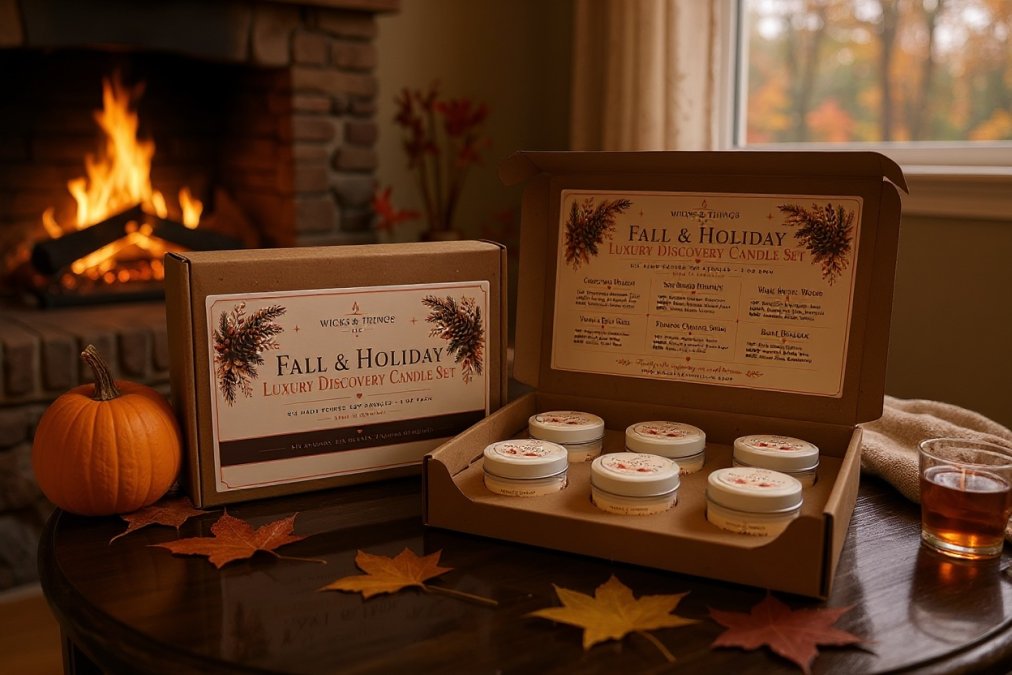
Top-down view of a candle discovery set with miniature votives and lavender, illustrating the variety of scents available.
Quick Comparison: Types of Candle Sample Packs
The right format depends on how you plan to use the set. Here's how the three main options compare.
Format |
Typical Burn Time |
Best For |
Scent Throw |
|---|---|---|---|
Tealights |
4-6 hours each |
Quick testing, warmers |
Light |
Votives |
12-15 hours each |
Room-by-room testing |
Moderate |
Travel tins |
15-25 hours each |
Gifting, travel, full evaluation |
Strong |
Tealights, Votives, and Travel Tins: Which Format Fits Your Goal
Pick tealights to test many scents fast, the short burn time keeps costs down and lets you rotate a full collection in a week or two.
How to Choose the Right Scent Profile in a Discovery Kit
Start with what you know you like, then branch out one step: vanilla lovers should try warm amber or tonka, citrus lovers a green or herbal scent. Most people find favorites one or two notes from their go-to.
Reading Fragrance Notes: Top, Heart, and Base
Every scented candle is built in three layers: top notes hit first and fade within minutes, heart notes form the body through the middle of the burn, and base notes anchor everything and linger longest.
Why a Luxury Soy Candle Sampler Beats a Blind Buy
A luxury soy candle sampler solves home fragrance's biggest problem: you can't smell a candle through a screen. Reviews help, but scent is personal, one reviewer's "cozy vanilla" is another's "birthday cake."
Scented Candle Burning Tips for Sample-Size Vessels
Small vessels need different handling than full-size jars. Follow these scented candle burning tips to get the most from every sample.
- Trim the wick to 1/4 inch before every burn
- Let the wax pool reach the edge on the first burn
- Burn for no more than 2 hours at a time in small vessels
- Keep samples away from drafts, which shorten burn time
- Use a candle warmer for tealights if you want zero flame
Fragrance Layering for Home: Pairing Scents from Your Set
Fragrance layering for home means burning two or more complementary scents at once or in sequence to build a custom aroma. Most candle discovery sets are sold as sampling tools only, missing the real payoff: six to twelve mini candles are also a layering kit, giving you the building blocks you'd otherwise buy separately.
The Three Layering Methods
Simultaneous burn. Light both candles at once in the same room, the boldest method and the easiest to get wrong. Start with one candle twice the size of the other, or twice as far from your seating area; a 2:1 throw ratio keeps the blend legible, while equal-sized candles of equal throw cancel each other out.
Pairings That Work, and Why
- Vanilla + cedar. Vanilla is a heavy base note; cedar is a dry mid note. The vanilla softens cedar's sharpness and the cedar keeps vanilla from reading like dessert. Best for a living room.
- Citrus + basil. Both are top-note heavy, so this pairing is bright and short-lived. Burn it in a kitchen where you want a 30-minute reset, not an all-evening scent.
- Lavender + eucalyptus. Two mid notes that share a camphoraceous quality. Together they read clean and slightly medicinal, which is why this pairing dominates bedroom and bathroom sets.
- Amber + tobacco. Two base notes. This is the riskiest pairing on the list because both are heavy and sweet; use a 3:1 ratio with amber as the dominant note or the room will smell like a cigar lounge.
- Sea salt + driftwood. An aquatic top note over a woody base. This is the most forgiving cross-family pairing and a good first experiment if you're new to layering.
Cross-Family Pairings: The Rule of Contrast
Pairing within a family (warm with warm, fresh with fresh) is safe but predictable. Cross-family pairings are where discovery sets earn their keep, because you can test a risky combination for the cost of two tealights instead of two $40 jars.
Room-by-Room Sequencing
One discovery set can carry a whole home if you sequence it deliberately:
- Kitchen: citrus, herbal, or green scents. Burn short. These are top-note profiles that fade fast, which suits a room you pass through rather than sit in.
- Living room: amber, vanilla, cedar, tobacco. Burn long. Base-note profiles reward a two-hour burn.
- Bedroom: lavender, eucalyptus, chamomile, sandalwood. Burn 30-60 minutes before sleep, then extinguish.
- Bathroom: sea salt, eucalyptus, mint. High throw in a small room means you can use a tealight and still fill the space.
- Entryway: something bright and short, bergamot, grapefruit, or a green scent. You want a first impression, not a lingering one.
Troubleshooting a Muddy Blend
If two candles together smell worse than either alone, the problem is almost always throw imbalance, not chemistry. Extinguish the weaker-throwing candle and air the room for 20 minutes: if the remaining candle reads well alone, the pairing was the issue; if it still reads flat, it may be under-throwing for that room size, useful information for your full-size purchase.
Blind Testing Your Candle Discovery Set: A Simple Method
Blind testing removes scent shopping's biggest bias: the label. Most of us buy the story, not the smell, a name like "Fireside Amber" sells a feeling that contaminates your judgment before the wick is lit. Blind testing strips the story out and leaves only the scent.
Step 1: De-Identify the Samples
Remove every candle from its packaging and write a number on the base of each vessel with a permanent marker, 1 through however many samples you have. Never write the scent name on the candle; if a vessel is too small to mark, set it on a numbered index card.
Step 2: Standardize the Test Conditions
A blind test is only useful if every sample gets identical treatment. Fix these variables first:
- Same room. Use one room for every test. A bedroom and a living room have different air volumes and will give you different results for the same candle.
- Same time of day. Scent perception shifts with fatigue and hunger. Evening tests tend to read sweeter and heavier than morning tests.
- Same burn duration. 45 minutes per sample. Long enough for a full melt pool and a stable hot throw, short enough to test one per day.
- Same distance. Sit the same distance from the candle every time. Six feet is a reasonable default.
- No competing scents. No cooking, no air freshener, no perfume, no open windows onto traffic. A single competing odor can flatten your perception of the sample.
Step 3: Score on Four Axes, Not One
A single "do I like it" score is too coarse. Score each sample 1-5 on four axes:
- Cold throw, how strong is the scent before lighting?
- Hot throw, how strong is it 30 minutes after lighting?
- Character, do you actually like the scent, independent of strength?
- Wear, does it still smell good after an hour, or does it turn cloying, sharp, or headache-inducing?
Step 4: Calibrate for Room Size
This step, which most blind-test guides skip, saves you the most money.
- A sample that throws strongly in a room under 150 square feet will likely throw moderately in a 300-square-foot room at full size.
- A sample that throws weakly in a small room will almost certainly disappear in a large one, regardless of vessel size.
- A sample that throws strongly in a large room is a safe full-size buy for any space.
Step 5: Reveal and Rank
After scoring every sample, open the key. Rank your top three by total score, then cross-reference the four axes: high character and wear but low hot throw suits a bedroom, while high hot throw but low wear suits an entryway or short-burn kitchen.
Step 6: Match the Winner to the Room
The final step turns a blind test into a purchase decision. Ask three questions about your top-ranked sample:
- What room did I test it in, and how big is that room?
- Is that the room I actually want this scent in?
- If not, does the candle's throw profile match the room I do want it in?
What to Do With a Sample That Fails
Not every sample earns a full-size purchase, that's the point of the set. A failed sample still rules out a scent family, a note, or a brand's fragrance style, so log it alongside the successes. After using discovery sets, your failure log becomes a reliable filter against re-buying the same disappointing profile under a different name.
Conclusion
Picking a candle by name and hope is a coin flip. A candle discovery set turns that guess into a test, and the results usually surprise you. Wicks & Things LLC hand-pours every sampler in small batches with premium soy wax and fragrance oils, so what you test is what you get in full size.
Frequently Asked Questions
What is a candle discovery set?
A candle discovery set is a curated collection of miniature candles, usually tealights, votives, or travel tins, that lets you sample several scents before buying a full-size jar. Most sets include several fragrances from one brand, so you can compare scent profiles side by side. They are popular with gift-givers and anyone exploring home fragrance without committing to a single large candle.
Are candle discovery sets worth the investment?
They usually cost less than two full-size candles and let you test scent throw, burn time, and fragrance notes in your own space. If you have ever bought a jar that smelled great cold but faded once lit, a discovery set removes that risk.
How do you choose the right candle scent for your home?
Start with the room's function. Kitchens and living rooms suit citrus, herbal, or clean cotton notes; bedrooms work well with lavender, vanilla, or sandalwood. Then match the season: lighter florals in spring, warm spice and amber in fall and winter. A discovery set lets you test two or three candidates in the actual room before deciding which one fills the space best.
How long should you burn a travel-sized candle for the best scent throw?
Burn a travel tin or votive for one to two hours the first time, or until the melted wax pool reaches the edge of the vessel. This prevents tunneling and sets an even burn for later uses. Small vessels usually deliver their strongest hot throw within the first 30 minutes, so test in a closed room to judge scent intensity accurately.
